How AI Is Changing Car Repair: Can Artificial Intelligence Really Diagnose Engine Problems?
AI in car repair is becoming increasingly common as artificial intelligence enters automotive diagnostics. Five years ago, many mechanics would have laughed at the idea that a smartphone could listen to an engine and help identify a mechanical problem. Today, AI-powered tools are beginning to change how drivers and mechanics approach engine diagnostics.
I am not talking about science fiction. I am talking about technology that is already being tested in real garages.
But does this mean AI will replace mechanics?
I don’t think so.
I believe the future of car repair belongs to mechanics who know how to combine practical experience with modern diagnostic technology.
And there is one area I find particularly interesting: diagnosing engine problems through sound.
An experienced mechanic has something that is difficult to teach: trained hearing.
How AI in Car Repair Is Helping Mechanics Diagnose Engine Problems
A mechanic can listen to an engine and recognize a familiar ticking, knocking, rattling, or squealing noise. Sometimes, an experienced specialist can narrow down the possible problem before even opening the hood.
But not every driver has that experience. And not every car owner has access to a mechanic when an unusual noise appears.
This is where AI can help.
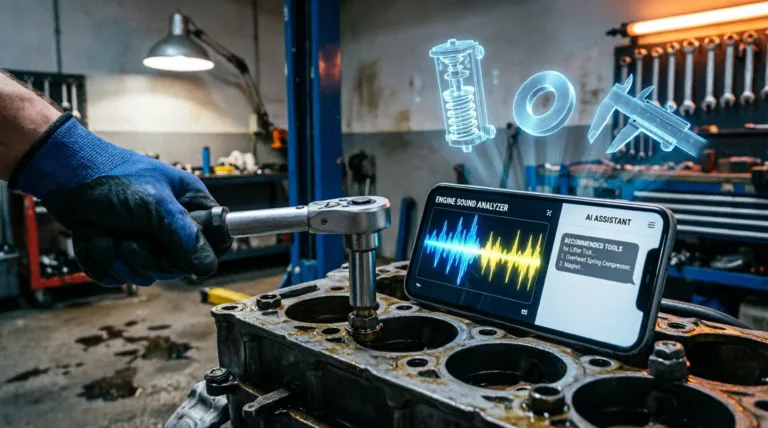
An AI engine sound diagnosis system analyzes an audio recording and looks for patterns associated with different engine operating conditions and possible mechanical faults.
It can examine:
- Frequency distribution.
- Repeating acoustic patterns.
- Changes in sound intensity.
- Unusual vibrations captured through sound.
- Differences between normal and abnormal engine noise.
Researchers are already investigating these methods.
For example, a 2024 study published in Applied Sciences explored engine fault detection using sound analysis and machine learning. The researchers used acoustic features, including Mel-Frequency Cepstral Coefficients (MFCCs), and machine learning classification to distinguish between different vehicle conditions.
The study reported promising classification results, although performance in research conditions should not be confused with guaranteed accuracy on every real-world vehicle.
You can read the full research paper here:
https://www.mdpi.com/2076-3417/14/15/6532
The important point is that engine sound analysis is not science fiction. It is an active area of automotive engineering research.
Why Engine Sound Is an Important Diagnostic Signal
Modern vehicles have numerous electronic sensors and monitoring systems.
They measure parameters such as:
- Engine temperature.
- Oil pressure.
- Oxygen sensor readings.
- Airflow.
- Crankshaft position.
- Engine speed.
- Combustion-related operating conditions.
However, not every mechanical problem produces an electronic fault code.
A worn component, unusual mechanical clearance, or developing noise may require physical inspection and additional diagnostic methods.
Sound provides another source of information.
For example:
| Engine sound | Possible source | What should be checked |
|---|---|---|
| Repeated ticking | Hydraulic lifters or valve mechanism | Oil supply, lifters, valve clearance |
| Deep metallic knocking | Connecting rod bearings or other internal components | Oil pressure, bearing condition, engine operation |
| High-pitched squealing | Belt or pulley | Belt tension, alignment, pulley bearings |
| Irregular rattling | Loose components or timing system | Timing components, fasteners, accessories |
| Uneven engine operation | Ignition or combustion problems | Spark plugs, coils, injectors, compression |
These are possible associations, not definitive diagnoses. Several different problems can produce similar sounds.
That is exactly why combining sound analysis with other diagnostic methods is important.
Sound Diagnosis vs. OBD2: What Is the Difference?
One of the most interesting developments is the possibility of combining acoustic analysis with conventional electronic diagnostics.
OBD2 is extremely useful, but it does not tell the whole story.
The onboard diagnostic system monitors specific vehicle systems and records diagnostic trouble codes when certain faults are detected.
An OBD2 scanner can retrieve these codes and provide valuable information about the vehicle.
However, a trouble code does not always identify the exact failed component. Additional testing is often necessary.
The following comparison explains the differences.
One of the biggest advantages of AI in car repair is the ability to combine different sources of diagnostic information. Instead of relying on electronic fault codes alone, mechanics can use sound analysis and AI-powered tools to investigate possible mechanical problems.
| Feature | AI sound diagnosis | OBD2 scanner | Professional mechanic |
|---|---|---|---|
| Listens to engine noise | Yes | No | Yes |
| Reads electronic fault codes | No, unless integrated | Yes | With diagnostic equipment |
| Identifies possible mechanical noises | Yes | Limited | Yes |
| Checks sensor data | Not from audio alone | Yes, supported parameters | Yes, with equipment |
| Physical inspection | No | No | Yes |
| Can work without an OBD2 connection | Yes | No | Yes |
| Requires practical experience | Helpful for interpretation | Helpful for interpretation | Essential |
Official information about OBD systems is available from the US Environmental Protection Agency:
The important difference is that sound analysis and OBD2 do not compete with each other. They provide different types of information.
A combination of both can give a more complete picture of engine condition.
How AI Engine Sound Diagnosis Works
A typical AI sound diagnosis system follows several stages.
1. Audio recording
The driver records the sound of the running engine using a smartphone microphone.
2. Audio processing
The recording is processed to reduce irrelevant noise and prepare the signal for analysis.
3. Feature extraction
The system examines acoustic characteristics, including frequency distribution and repeating patterns.
4. AI classification
A machine learning model compares the extracted features with patterns learned from previously collected engine recordings.
5. Diagnostic result
The system produces a prediction or identifies a possible abnormal sound.
The process sounds simple, but building a reliable system is difficult.
The biggest challenge is not simply recognizing a ticking noise. It is understanding whether that noise comes from a hydraulic lifter, an injector, a valve mechanism, or another component.
Different engines produce different acoustic patterns. Engine speed, temperature, microphone quality, recording distance, and background noise can all influence the result.
A model trained on one type of engine may not perform equally well on another.
This is why collecting real recordings from different vehicles and operating conditions is so important.
EngineEar AI and the Growing Interest in Sound-Based Diagnostics
Tools such as EngineEar AI are examples of the growing interest in using artificial intelligence to analyze vehicle sounds.
The basic idea is straightforward: instead of relying only on electronic fault codes, the driver can provide an audio recording and receive an initial assessment.
I have also tested EngineEar AI and our own sound diagnosis system.
What interests me most is not which tool has the most impressive interface. It is how accurately a system can interpret a real recording from an actual vehicle.
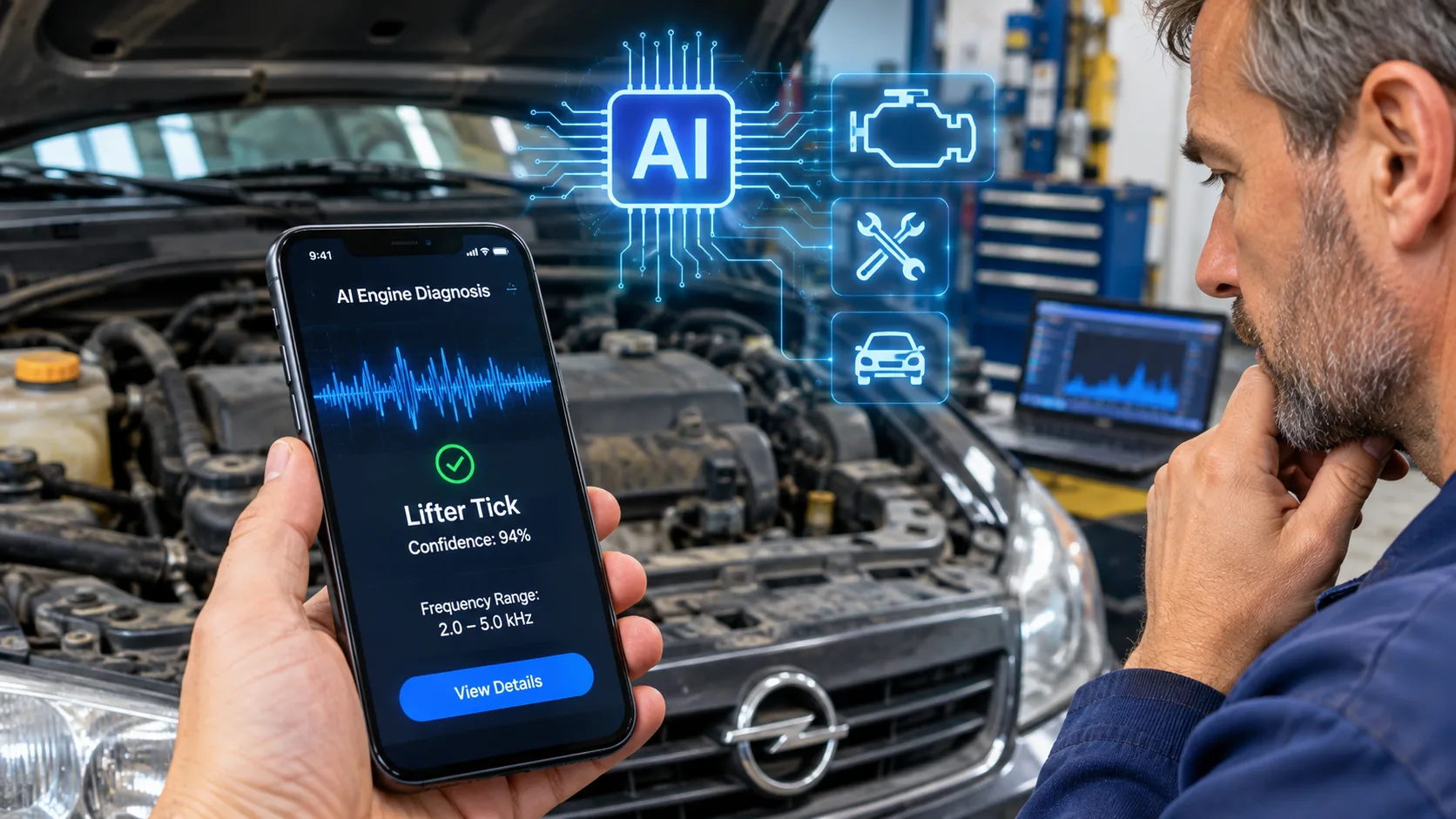
For this reason, I tested our own AI engine sound diagnosis tool on my 1993 Opel Vectra.
The engine had been making a noticeable ticking noise, especially during cold starts.
I recorded approximately five seconds of engine sound and uploaded the recording.
The system identified possible hydraulic lifter noise.
I already suspected the hydraulic lifters, but I wanted to see whether the analysis would point in the same direction.
Later, I replaced the lifters myself. The ticking disappeared after the repair.
This was a useful real-world test because I could compare the initial sound analysis with what I found during the actual repair.
You can read the complete story here: I Replaced Hydraulic Lifters on My 1993 Opel Vectra and Dropped a Shim Into the Engine.
This does not prove that an AI system can diagnose every engine problem correctly. It does show why real-world testing matters.
What AI Can Already Do in a Garage
I see several practical areas where AI can help drivers and mechanics.
1. Engine Sound Diagnosis
A driver records an unusual engine noise and uploads the audio to an AI-powered diagnostic tool.
The system analyzes the recording and identifies possible problems, such as ticking, knocking, or squealing.
A car sound diagnosis app free can be particularly useful for an initial assessment without purchasing additional hardware.
2. OBD2 Code Interpretation
A driver connects an inexpensive OBD2 adapter and retrieves a diagnostic trouble code.
AI can then explain what the code means in ordinary language.
For example, instead of simply displaying P0301, the system can explain that the engine control module detected a misfire in cylinder 1.
It can also suggest which components should be checked first.
However, the code does not automatically mean that a particular component needs replacement.
3. Repair Cost Estimation
Another useful application is estimating repair costs.
An AI assistant could consider:
- Vehicle make and model.
- Engine type.
- Year of manufacture.
- Possible fault.
- Local parts prices.
- Labor costs.
This could help drivers understand whether a repair estimate is reasonable.
Actual costs still depend on the vehicle, location, parts availability, and the results of physical inspection.
4. Parts Identification
Finding the correct spare part can be difficult, especially for older vehicles.
AI could help identify compatible components, compare part numbers, and explain the differences between original and aftermarket replacements.
This would be particularly useful for owners of older vehicles that are no longer supported by official dealerships.
What AI Cannot Do Yet
There is a lot of enthusiasm around artificial intelligence, but it is important to understand its limitations.
AI cannot physically inspect an engine.
It cannot:
- Measure actual oil pressure without a suitable sensor.
- Check bearing clearance.
- Measure cylinder compression.
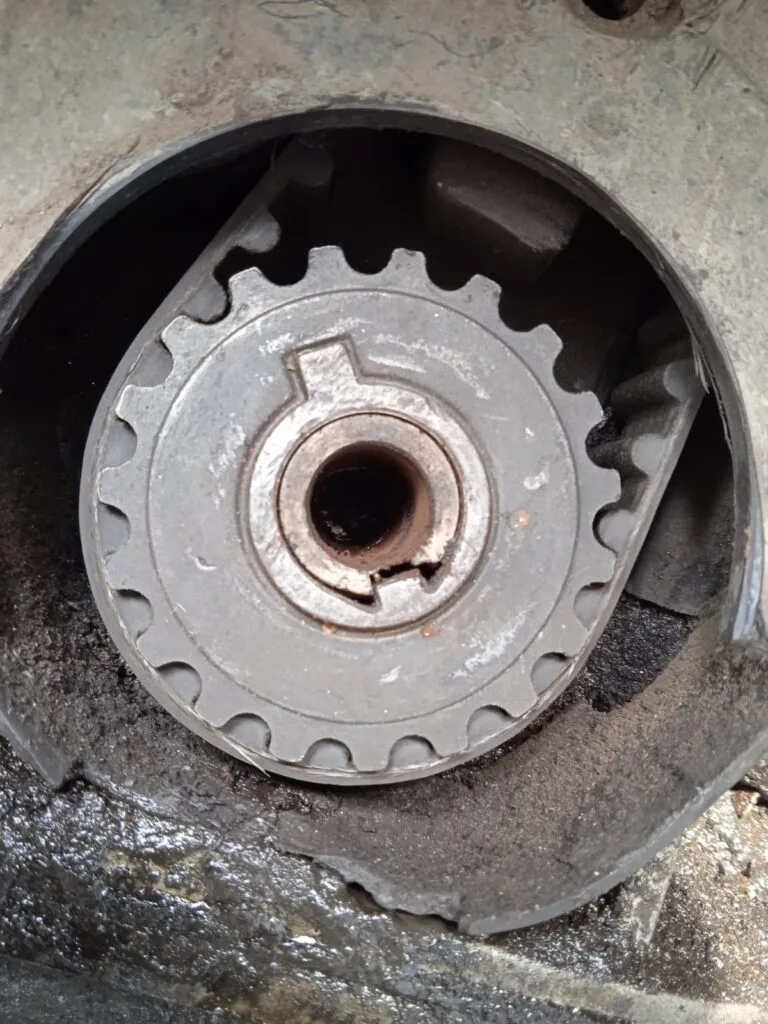
- Inspect a damaged timing belt.
- Replace a hydraulic lifter.
- Feel mechanical vibration with a hand.
- Confirm every suspected fault without additional testing.
Sound-based diagnosis also has limitations.
Wind, traffic, other running engines, poor microphone quality, and incorrect recording distance can reduce the quality of the analysis.
Another important problem is overlapping sounds.
For example, hydraulic lifters and other components can sometimes produce similar ticking noises. A prediction based only on audio may not be enough to distinguish between them.
AI can make mistakes, too.
For serious symptoms, especially loud metallic knocking, sudden loss of power, oil pressure warnings, or overheating, do not rely on an app to decide whether it is safe to continue driving. Stop safely and arrange a proper inspection.
AI should help people make better decisions, not encourage them to ignore mechanical problems.
How to Get a Better Engine Sound Recording
If you want to try an AI engine sound diagnosis tool, the quality of the recording matters.
Here are a few practical recommendations:
- Park the vehicle in a relatively quiet location.
- Keep the vehicle stationary.
- Make sure the engine is running under the conditions you want to investigate.
- Hold the phone approximately 20–30 cm from the engine, away from moving belts, fans, and hot components.
- Avoid touching the engine or placing the phone near moving parts.
- Record a few seconds of clear audio.
- If the noise occurs only during a cold start, record it before the engine warms up.
For a more useful comparison, you can also record the engine after it reaches normal operating temperature.
Keep in mind that different recording conditions can change the sound. Ideally, use the same phone position and recording method when comparing two recordings.
My Opinion: Mechanics Who Use AI Will Have an Advantage
I do not believe AI will eliminate the need for experienced mechanics.
Quite the opposite.
A mechanic who understands engines, knows how to use diagnostic equipment, and can interpret AI results may have an advantage over someone who refuses to use new tools.
Imagine a customer arriving at a repair shop with an unusual ticking noise.
The mechanic listens to the engine, checks the relevant systems, and compares the findings with an AI sound analysis.
Instead of relying on one observation, there are now several sources of information.
The mechanic still makes the final decision.
AI simply provides another way to examine the problem.
In my opinion, this is the most realistic future for automotive diagnostics.
What Will Happen Next?
I expect AI-based vehicle diagnostics to become more common over the next few years.
Smartphones will become more capable, machine learning models will improve, and developers will collect larger databases of real engine recordings.
We may eventually see more vehicles with built-in acoustic monitoring systems capable of recognizing unusual operating sounds.
But there is still a long way to go.
One of the biggest challenges will be developing diagnostic systems that work reliably across different engine types, vehicle ages, temperatures, and real-world recording conditions.
Research in this area is already moving forward.
For anyone interested in the technical side, these studies are worth reading:
- Engine Fault Detection by Sound Analysis and Machine Learning — Applied Sciences, 2024
- Audio-Based Engine Fault Diagnosis with Wavelet and Machine Learning Classifiers — Sensors, 2024
- Noninvasive Methods for Fault Detection in Internal Combustion Engines Based on Sound Analysis — Sensors, 2021
These publications demonstrate that acoustic analysis and machine learning are serious areas of automotive engineering research, although practical performance still depends on the data, engine types, and testing conditions.
Final Thoughts
Artificial intelligence is not going to repair your car for you.
It will not remove a cylinder head, replace worn bearings, or install new hydraulic lifters.
But it can help identify unusual sounds, explain diagnostic codes, suggest possible causes, and make automotive diagnostics more accessible to ordinary drivers.
That is already a useful development.
I am particularly interested in the combination of practical mechanical experience and AI-based sound analysis.
This is also the direction we are exploring with our own AI-Garage project: using artificial intelligence to help drivers understand what their engines are telling them.
If your engine has started making an unusual noise, you can try recording it and using a car sound diagnosis app free to get an initial assessment.
It will not replace a mechanic, but it may give you a better idea of what to investigate next.
And if you decide to repair the engine yourself, remember: experience still matters.
AI can listen to your engine. A good mechanic knows what to do next.
Disclaimer: This article reflects the author’s personal opinion and experience with automotive repair and AI-based diagnostic tools. Sound analysis provides preliminary information and does not constitute a confirmed mechanical diagnosis. Always consult a qualified mechanic when dealing with potentially serious engine faults. Research results do not guarantee the same accuracy in every vehicle or real-world situation.
The future of AI in car repair will depend on combining artificial intelligence, reliable diagnostic data, and the practical experience of professional mechanics.
Now that your fuel leak is patched and you’re ready to drive, it’s time to check what else is going on under the hood. If you’re hearing strange engine knocks, see what happened when we stress-tested a [car noise diagnostic tool] in our latest AI-Garage experiment.
Repair Cost Calculator
How much will your car repair cost? Select your car and the fault, and see the average price for parts and labor in the US.
Most drivers overpay because they do not know the real price before they go to the shop. This calculator helps you check.
Example: Lifter replacement on a 1993 Opel Vectra costs about $66 in parts if you do it yourself, and $250 to $400 in a US shop with labor. Rod knock repair costs $800 to $1 500. Valve adjustment costs $150 to $300.
How to use: Select your car brand, select the fault, click Calculate. You will see the average cost.
Tip: Before you go to the shop, record 5 seconds of engine sound and use our free car sound diagnosis app. Our AI engine sound diagnosis tool will tell you if it is lifters, valves, or rod knock in 15 seconds. Then you will know what to ask the mechanic.
Disclaimer: Prices are averages for the US market. Actual cost depends on your car model, year, and city. Get a quote from a qualified mechanic for an exact price.
Engine Repair Cost Calculator
Estimate internal combustion engine repair costs for popular makes in the USA. Prices in US dollars.
Vehicle & shop
Repairs needed
Estimated cost
Estimates only, based on typical US averages for mid-range vehicles. Actual quotes vary by model year, engine, parts brand, and shop. Get a written quote before authorizing work. Sales tax, towing, and fluids are not included.