
Stop Guessing: The Ultimate DIY Engine Sound Diagnosis Guide
Аi car noise diagnostic tool. We’ve all been there. You’re driving down the highway, the radio is playing, and suddenly you hear it. A weird rattle. Or maybe a high-pitched whine. You turn down the volume, hoping it goes away. It doesn’t.
Figuring out what’s happening under the hood usually means either a stressful trip to the mechanic or spending hours scrolling through forums. But diagnosing engine sounds doesn’t have to be a guessing game anymore. Whether you prefer the old-school grease-monkey methods or want to use a modern app that listens to car engine and tells you whats wrong, this guide covers exactly how to pinpoint the problem.
The Old-School Way: Diagnose Engine Noise with a Long Screwdriver Trick
Long before we had advanced OBD2 scanners and smartphones, mechanics used incredibly simple physics to locate bad bearings or ticking lifters.
If you don’t have specialized tools yet, you can literally diagnose engine noise with a long screwdriver trick. Here is how it works: take the longest, thickest flathead screwdriver you own. Place the metal tip carefully against the metal part of the engine you suspect is making the noise (like the alternator housing or valve cover). Press your ear tightly against the plastic handle.
The solid metal acts as a direct acoustic bridge, transferring the vibration straight to your ear and blocking out the background noise of the spinning belts. It’s an old trick, but it works surprisingly well.
However, if you plan on doing your own maintenance regularly, you really should step up your game. Knowing how to use a mechanic stethoscope to find engine noise is a basic skill every DIYer needs. It works on the exact same principle as the screwdriver, but with a proper acoustic chamber that makes pinpointing a failing water pump incredibly easy.
Tool Upgrade: Stop risking your ears near moving fan blades. Grab a specialized tool.
Decoding Common Engine Noises (The Quick Table)https://amzn.to/4u1rNBW
So, you’ve pinpointed where the noise is coming from. But what does it mean? Here is a quick breakdown of the most common complaints we see in the garage.
| The Sound You Hear | When It Happens | Most Likely Culprit | DIY Fix Difficulty |
| High pitched squeal from engine area when accelerating | Pushing the gas pedal, cold mornings | Slipping serpentine belt or failing belt tensioner pulley. | Easy to Medium. (Check out [Amazon Affiliate Link: Serpentine Belt Tool Kit]) |
| Deep, repetitive knocking (Rod Knock) | Deep inside the engine block, speeds up with RPMs | Worn out connecting rod bearings. Engine is in serious trouble. | Expert (Requires engine rebuild or replacement). |
| Light, rapid ticking/clicking | Top of the engine, mostly at idle | Low oil pressure, or a sticky hydraulic valve lifter. | Medium. Sometimes an oil flush helps. |
| Hissing sound | While the engine is running | Vacuum leak in the intake hoses. | Easy. Find the cracked hose and replace it. |
Pro Tip: Before tearing your engine apart, always check the basics. According to the experts at the National Institute for Automotive Service Excellence (ASE), many perceived engine failures are actually just loose heat shields or low fluid levels.
The Modern Solution: Use an AI Mechanic Engine Sound Analyzer
Let’s be real. The screwdriver trick is cool, but unless you’ve spent ten years listening to failing alternators, a high-pitched squeal can sound exactly like a vacuum leak to an untrained ear.
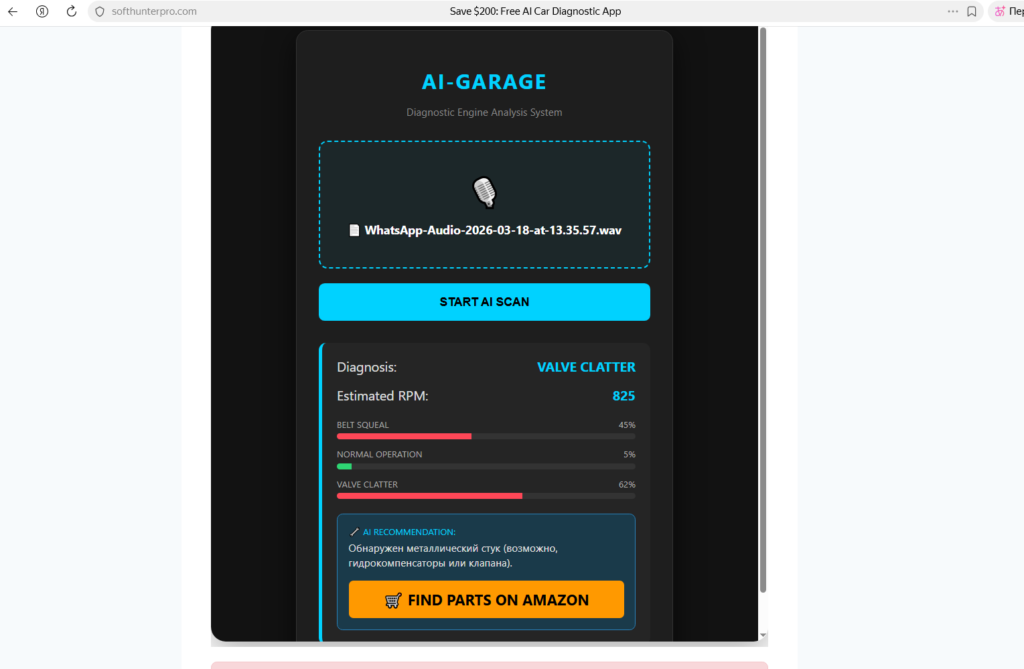
This is where the game has completely changed. You no longer need to rely purely on your own ears. You can now use an ai mechanic engine sound analyzer right from your phone.
At SoftHunterPro, we integrated a system specifically for this. If you are standing in your driveway right now wondering why your car sounds like a tractor, you can use our ai car noise diagnostic tool free of charge.
How to Identify Engine Sound Online Free
You don’t need to download a heavy application or buy expensive diagnostic equipment just to figure out a noise.
- Pop your hood and make sure you are in a relatively quiet environment (avoid busy streets if possible).
- Open our AI-Garage Diagnostic Tool (Note: Insert internal link to your AI-Garage page here) on your smartphone’s browser.
- Hit record and hold your phone near the source of the sound for about 10 seconds.
- The AI will analyze the acoustic waveform against thousands of known engine failures and tell you exactly what is wrong.
It’s the ultimate diy engine sound diagnosis guide in your pocket. It cross-references frequencies you can’t even hear properly, distinguishing a failing power steering pump from a dying AC compressor clutch in seconds.
Аi car noise diagnostic tool. Final Thoughts
Whether you are buying a used car and want to check the engine health, or you’re just trying to figure out why your daily driver is whining, you have options. Grab a mechanic’s stethoscope for the physical pinpointing, and let our AI handle the audio analysis.
Got your diagnosis? Make sure you have the right gear to fix it.
Disclaimer & Safety Warning:
The information provided in this article and by the AI-Garage diagnostic tool is for educational and informational purposes only. Working on vehicles can be dangerous and carries the risk of injury or property damage. Always wear appropriate safety gear and consult your vehicle’s factory service manual before attempting any DIY repairs. SoftHunterPro and its AI tools are diagnostic aids and are not a substitute for a professional inspection by a certified, licensed mechanic. We are not responsible or liable for any damage, injuries, or voided warranties that may result from following the information or applying the techniques described on this website.
Affiliate Disclosure: SoftHunterPro is reader-supported. Some of the links in this article are affiliate links. This means that, at zero cost to you, we will earn an affiliate commission if you click through the link and finalize a purchase. As an Amazon Associate, we earn from qualifying purchases. This helps keep our AI tools free for the community.
Try it now: Got a strange engine noise? Upload your sound to our [Free AI Engine Sound Diagnosis Tool] and get an instant analysis.