HeyGen vs Synthesia vs Colossyan (2026): We Tested All 3 [Real Results]
🏆 Top Pick: HeyGen (Best Realism) — [Try Free Button]
💼 Best for Enterprise: Synthesia — [Try Free Button]
💰 Best Value: Colossyan — [Try Free Button]
Editor’s Note (Mid-2026 Update): The AI video generation landscape moves incredibly fast. We’ve revisited our original tests to factor in the latest platform capabilities, specifically focusing on emotional avatar control, automated gestures, and workflow integrations across HeyGen, Synthesia, and Colossyan.
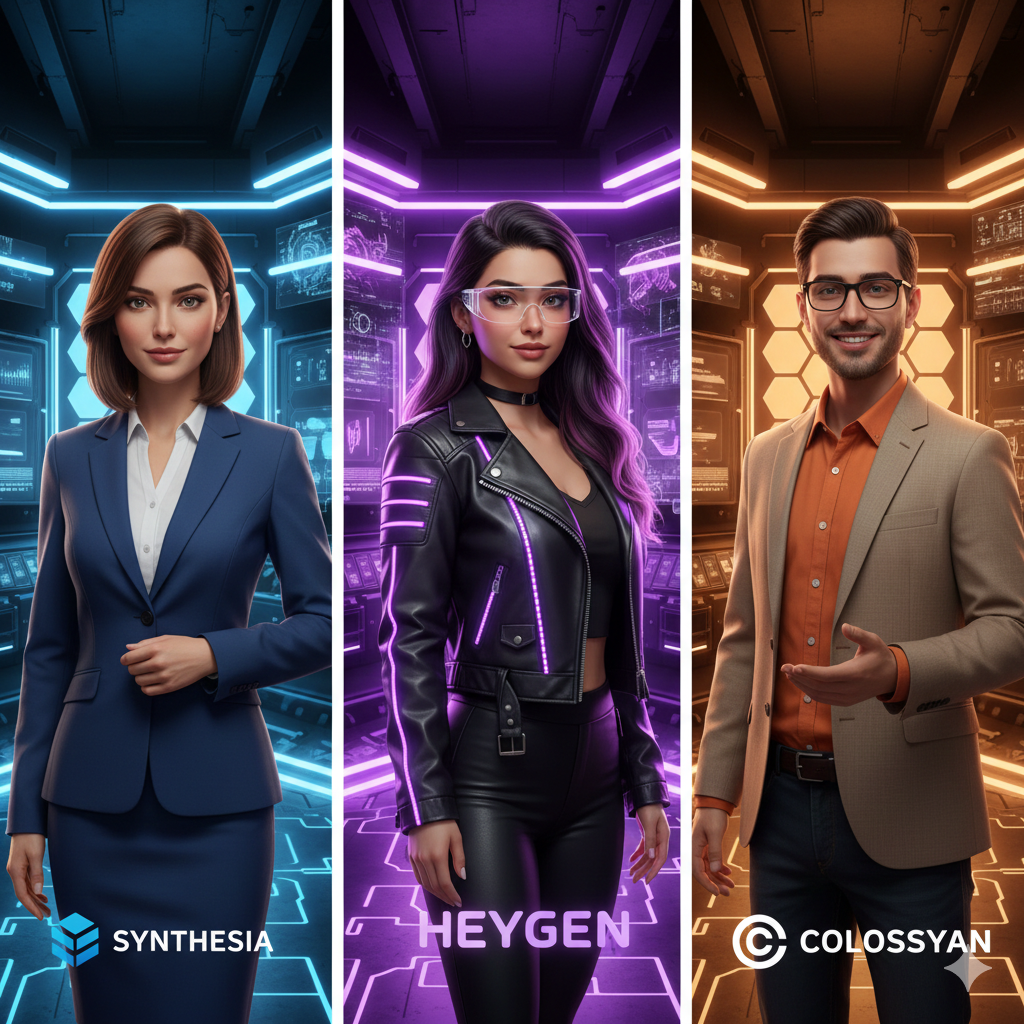
HeyGen vs Synthesia is the comparison people search because both are legit market leaders — and they’ve earned it. Synthesia is the corporate standard in a lot of enterprise orgs, while HeyGen moves fast and tends to ship creator/marketing-friendly features earlier.
But here’s the “dark horse” most people overlook: Colossyan. If your real world is training, enablement, and internal comms (not TikTok-style ads), it can be a surprisingly strong competitor — especially once you factor in interactivity and workflow.
For this 2026 battle, I’m keeping it simple: we judge all three on (1) realism & lip-sync, (2) voice quality, and (3) price/value. And yes — we’ll also answer the big trust question: is Synthesia safe?
The Contenders at a Glance
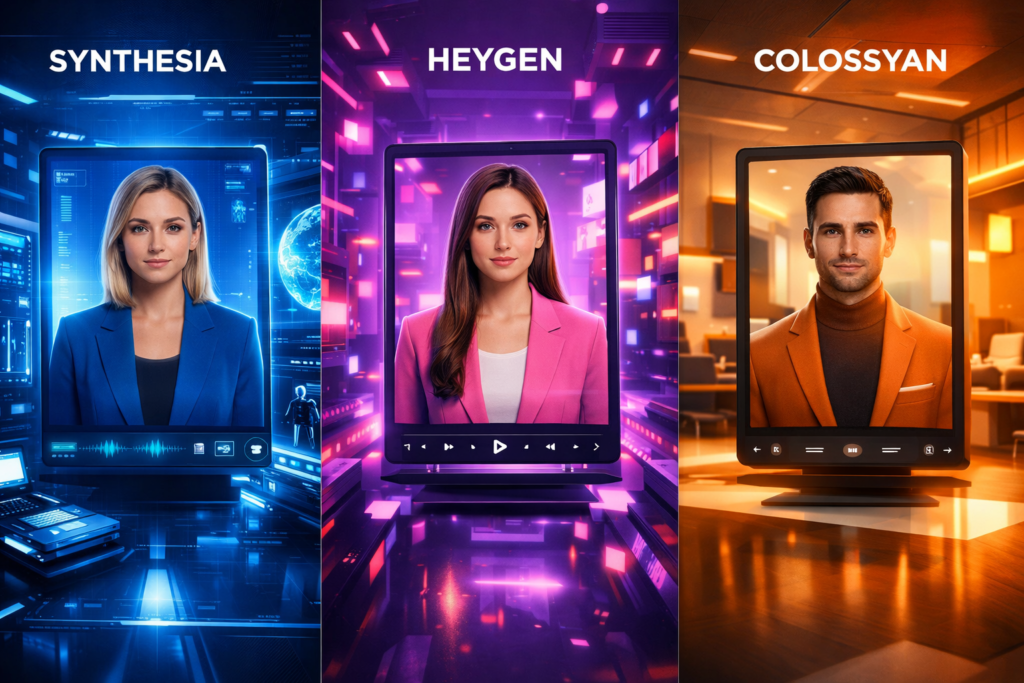
HeyGen (The Innovator)
HeyGen is built for speed: marketing teams, creators, and agencies who need output now — with strong avatar motion, aggressive feature releases (translation, voice integrations, cloning), and an overall “creator-first” feel. It also positions itself as an AI avatar generator for business, not just a toy maker. “If you plan to use these avatars for social media, check out our guide on [how to start a faceless YouTube channel].”
👉 Check out HeyGen Official Site
Synthesia (The Corporate Standard)
Synthesia is what a lot of large companies buy when they want consistency, governance, and clean workflows for training/comms. Their security posture and compliance messaging are a big deal in enterprise environments (we’ll get to that). Pricing is more “business software” than “creator tool.”
👉 Check out Synthesia.io
Colossyan (The Learning & Development Specialist)
Colossyan is clearly tuned for workplace learning and enablement. The differentiator isn’t just avatars — it’s interactive video (branching, quizzes) and training-first features that can save you from buying a separate interactivity layer.
👉 Check out Colossyan.com
Pro Tip: If your KPI is “course completion” (not clicks), prioritize interactivity + SCORM + update workflow over “most realistic face.” The prettiest avatar doesn’t fix boring training.
Avatar Realism & Lip-Sync (The Visual Test)

When people search best AI avatar generator for business, what they really mean is: Will this look credible in a client-facing or executive-facing video? Here’s how I’d frame the reality:
HeyGen: more “alive” motion (usually)
HeyGen often wins on perceived motion and energy — the output tends to feel a bit more fluid and “creator-ready,” especially if you’re doing punchy marketing explainers. They also lean heavily into “digital duplicate” positioning (photo/video to avatar), which is why creators love it.
Synthesia: stable, polished, corporate-safe
Synthesia usually feels more consistent and conservative. Less “look at me” motion, more “this belongs in a company LMS.” For many businesses, that stability is a feature, not a bug.
Colossyan: catching up, but still training-first
Colossyan’s avatars are good enough for training, onboarding, internal comms — but if your top priority is ultra-human marketing realism, HeyGen/Synthesia typically have the edge. Where Colossyan fights back is workflow and learning features.
“Instant Avatar” / cloning yourself
All three support the “clone me” workflow — but with different vibes:
- HeyGen: “Digital Twin” style, with consent/verification baked in.
- Synthesia: “Personal Avatar” with explicit consent recording requirements.
- Colossyan: Instant avatars + voice cloning messaging, again with explicit consent constraints.
Pro Tip: The fastest way to get “uncanny” results is bad lighting + phone mic + a script with brand names. Record your avatar footage like a product shoot, not like a Zoom call.
Voice Quality & Text-to-Speech
Let’s talk about the thing that makes or breaks credibility: voice.
Native voices: who sounds best out of the box?
- Synthesia is strong for clean, corporate narration (think training, internal updates) with lots of language support and a controlled sound.
- HeyGen is strong for creator-style output and flexibility, and it’s aggressively expanding voice options.
- Colossyan leans into large voice libraries and localization workflows.
Synthesia vs HeyGen vs ElevenLabs (voice context)
Here’s the practical truth: ElevenLabs is a voice specialist. If voice is your #1 priority (ads, narrations, brand voice), you’ll end up comparing everything against ElevenLabs.
Now the key question: which platform plays nicest with it?
- HeyGen: integrates third-party voices like ElevenLabs directly, so you can use them inside HeyGen projects.
- Synthesia: supports importing an ElevenLabs Professional Voice Clone, but it’s handled as an enterprise workflow.
- Colossyan: uses third-party solutions (including ElevenLabs) in its stack.
My take:
- If you want the simplest “high-end voice inside avatar videos” workflow, HeyGen is currently the most creator-friendly.
- If you’re enterprise and want governance + managed workflows, Synthesia is cleaner.
Safety & Ethics: Is Synthesia Safe?
For business clients, “safe” usually means: compliance, controls, and predictable moderation.
Synthesia’s Security
Synthesia’s public trust/security materials state SOC 2 Type II compliance and certifications including ISO/IEC 27001:2022. They also require explicit consent practices for personal avatars.
So yes — for a typical business use case, Synthesia is positioned as “enterprise safe”.
HeyGen’s Protocols
HeyGen publishes a moderation policy with explicit consent requirements for custom avatars. They also publicly state SOC 2 Type II compliance and GDPR-oriented messaging.
Translation: both Synthesia and HeyGen take “business safety” seriously.
The “Colossyan” Factor: Why Consider It?

This is the section most “HeyGen vs Synthesia vs Colossyan” articles get wrong. Colossyan’s real edge is learning workflows:
- Interactive videos with branching and quizzes.
- Training-style production that’s easier to maintain and update at scale.
If your content is onboarding, compliance, or SOP training — Colossyan often gives you “good enough avatars” plus features that reduce tool sprawl.
API & Workflow Integrations (The Hidden Decider)
When you start scaling AI video production, logging into a standalone web app every day quickly becomes a bottleneck. You need these tools to connect with your existing tech stack. Here is how the big three handle integrations:
- HeyGen: Dominates the Zapier and Make.com ecosystems. If your strategy involves automatically generating personalized video outreach directly from CRM triggers, HeyGen’s API makes this surprisingly fluid for growth marketers.
- Synthesia: Focuses heavily on LMS (Learning Management System) integration and robust enterprise single sign-on (SSO). It’s specifically engineered to plug into strict corporate IT environments without triggering compliance alarms.
- Colossyan: Excels with native SCORM exports. If your L&D team relies on tools like Articulate Storyline or standard corporate training portals, Colossyan’s seamless export formats save hours of manual embedding.
Pricing Comparison
“When analyzing the HeyGen vs Synthesia pricing structure, value depends on your usage frequency.”
- HeyGen: Creator plan starts around $29/month (billed monthly).
- Synthesia: Has a Basic plan, with Starter around $29/month (billed monthly).
- Colossyan: Starter is around $27/mo.
Value note: Synthesia’s pricing is the most “SaaS-like,” HeyGen is the most creator-friendly on entry, and Colossyan tends to be attractive if you actually use interactive/L&D features.
Comparison Table (Crucial for SEO)
| Tool | Price/Month (entry) | Avatar Quality | Voice Quality | Best Use Case |
| HeyGen | $29 (Creator) | 9/10 | Strong + ElevenLabs integration | Marketing, creators, viral ads |
| Synthesia | $29 (Starter) | 8.5/10 | Very solid corporate TTS | Enterprise comms, security-focused orgs |
| Colossyan | $27 (Starter) | 7.8/10 | Large voice library + cloning | L&D, interactive training |
(Scores are my practical rubric for “how convincing this looks in typical business video,” not a lab measurement.)
Final Verdict: Which One Should You Buy?
Winner for Marketing / Viral Content: HeyGen
“Choosing a winner in the HeyGen vs Synthesia battle depends entirely on your business goals.” If your priority is output, motion, iteration speed, and voice flexibility (especially if you already use ElevenLabs), HeyGen is usually the easiest “get results fast” choice.
Winner for Enterprise Security: Synthesia
If procurement/security are involved, Synthesia’s trust posture and consent processes make it the safer bet for large organizations.
Winner for Corporate Training / L&D: Colossyan
If you build training that needs branching, quizzes, and scalable updates, Colossyan deserves serious consideration — it’s the “specialist” option.
Call to Action
If you’re still deciding, don’t overthink it — try the free versions and run the same test script in each tool:
- One short marketing clip (30–45s).
- One training clip (1–2 min).
- One translation sample.
My default recommendation for most readers is: Start with HeyGen + Synthesia as your top two, then add Colossyan if training is your main goal.
“Disclosure: This post contains affiliate links. If you make a purchase through these links, I may earn a commission at no extra cost to you. I only recommend tools I personally trust.”