Shazam for Engines? Testing AI Sound Diagnostics Apps vs. AI-Garage
Disclaimer: The information provided on SoftHunterPro is for educational and informational purposes only and should not replace professional mechanical advice. Always consult anASE-certified technicianbefore attempting major engine repairs or if your vehicle is unsafe to operate. This post contains affiliate links, meaning we may earn a small commission if you purchase tools or software through our links, at no extra cost to you.
Engine Sound Diagnostics. Every seasoned mechanic knows that a car engine talks to you. For decades, old-school diagnostics relied on a trained ear, a solid mechanic’s stethoscope, or a long screwdriver pressed against the block to isolate a failing bearing or a sticky lifter.
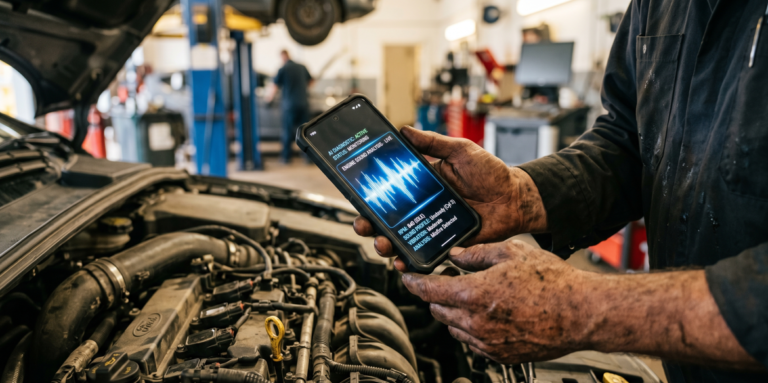
But as artificial intelligence takes over automotive tech, a new wave of software promises to turn your smartphone into an acoustic engineer. Can a mobile app really tell the difference between a minor piston slap and a fatal rod knock just by “listening” to the exhaust or oil pan?
Today, we are putting the most popular Android AI acoustic diagnostic tools to the test and comparing them to our own engineering project under development, AI-Garage.

The Contenders: Android AI Sound Diagnostics
1. AI Mechanic: Engine Sound Scan
Positioned by its developers as the ultimate “Shazam for cars,” this application focuses on identifying mechanical friction and abnormal vibrations based on vast acoustic databases.
- How it works: The app records engine noise and uses an acoustic neural network—similar to those researched by the IEEE Signal Processing Society—trained on thousands of known engine failure profiles.
- The Claim: It claims to successfully differentiate between top-end noise (like hydraulic lifter ticking) and catastrophic bottom-end damage (like rod bearing failure).
- The Reality: In a controlled garage environment, it provides a decent baseline report, estimating potential repair costs based on US market averages. However, high ambient noise—like a loud shop fan or an exhaust leak—can easily confuse the algorithm.
2. EngineEar AI
If you want raw speed without messing around with menus, EngineEar AI takes a more streamlined approach.
- How it works: It requires a quick 5-to-30-second audio sample captured via your phone’s built-in microphone. No OBD2 scanners, cables, or hardware required.
- The Claim: The AI categorizes the detected issue into four urgency levels: Low, Medium, High, or Critical, and immediately maps out actionable mechanical steps.
- The Reality: It excels at identifying clear, rhythmic top-end ticks or pulley squeals. It behaves less like a deep diagnostic lab and more like a first-responder triage tool for DIYers who aren’t sure if their car is safe to drive to the parts store.
Enter AI-Garage: The No-Nonsense Engineering Approach
While commercial apps try to be a “one-click fix” for the everyday driver, our internal project, AI-Garage, is being built from a different perspective—the perspective of practical, technical engineering.
Most consumer apps hide their data behind a simple screen that says, “Your engine is loud, go to a mechanic.” AI-Garage is designed to look at the actual physics of sound, aligning with standards often discussed by SAE International (Society of Automotive Engineers).
How AI-Garage Approaches Audio Analysis:
- Frequency Spectrum Mapping: Instead of just guessing based on a database, AI-Garage isolates specific sound frequencies. A loose timing chain, a failing alternator bearing, and a bent valve all operate at different frequencies and intervals relative to engine RPM.
- Acoustic Filtering: The biggest flaw in garage diagnostics is background noise. AI-Garage integrates noise-canceling filters to separate the core mechanical signature of the engine block from external factors like wind, garage echo, or a blowing exhaust gasket.
- DIY-First Logic: The goal isn’t just to flag an error code. It’s to tell the garage builder exactly which bolt to turn, which pulley to wiggle, and what mechanical clearance needs to be checked with a feeler gauge.
Essential Garage Hardware to Pair with AI Diagnostics
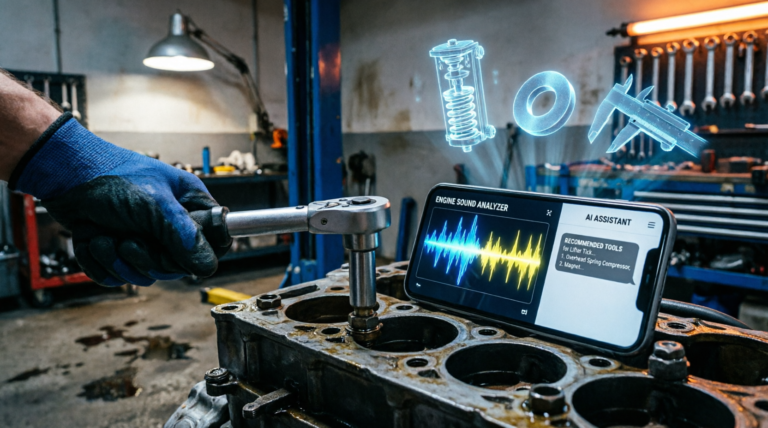
Even the best AI algorithm is only as good as the physical tools you use to verify its findings. If your app detects a valvetrain tick or an engine code, you will need the right hardware to confirm the diagnosis and execute the repair. Here is the no-nonsense gear we recommend keeping in your toolbox:
- [Lisle 52750 Mechanic’s Stethoscope] Before you tear down an engine based on a smartphone notification, use a physical stethoscope. It’s the undisputed king of isolating a noisy fuel injector or a dying water pump bearing. It cuts out the ambient noise that confuses algorithms.
- [BlueDriver Bluetooth Pro OBDII Scan Tool] Acoustic diagnostics are powerful, but they should be paired with actual ECU data. This scanner reads live data, pulls ABS/SRS codes, and gives you a complete digital picture alongside your audio tests.
- [OEMTOOLS Feeler Gauge Set] If the AI flags a mechanical clearance issue (like a noisy valve adjustment), this is the exact physical tool you need to slide between the rocker arm and the valve stem to verify the gap.
Summary Comparison: AI Acoustic Tools
| Feature / App | AI Mechanic | EngineEar AI | AI-Garage (In Development) |
| Core Focus | Broad defect database | Quick triage & urgency | Deep frequency spectrum analysis |
| Platform | Mobile (Android/iOS) | Mobile (Android/iOS) | Hybrid (Mobile Capture + PC Dashboard) |
| Target Audience | Everyday drivers | Beginners & DIYers | Advanced DIYers & Garage Engineers |
| Noise Filtering | Basic | Basic | Advanced (Mechanical signature isolation) |
| Repair Guidance | Cost estimates | Basic next steps | Torque specs, tool recommendations |
Engine Sound Diagnostics. The Engineering Verdict
Are AI sound diagnostic apps ready to replace mechanical tools completely? Not yet. A smartphone microphone has physical limitations, and no algorithm can replace physical inspection with a torque wrench and a solid understanding of automotive mechanics.
However, as a first line of defense, apps like EngineEar AI and AI Mechanic are proving that neural networks can catch early-stage bearing failures long before they show up on a standard dashboard cluster. And with tools like AI-Garage pushing for deeper, more transparent frequency analysis, the future of DIY garage diagnostics is looking incredibly sharp.
Try it now: Got a strange engine noise? Upload your sound to our [Free AI Engine Sound Diagnosis Tool] and get an instant analysis.
“If you want to understand the core physics behind these acoustic signatures, check out our previous deep-dive into [how to diagnose engine issues by sound]